The Official Cannabis Independent strain guides
The Official Cannabis collection · sheet 31No 31 · GuavaUniverse

The Guava universe

The Dawn Porter

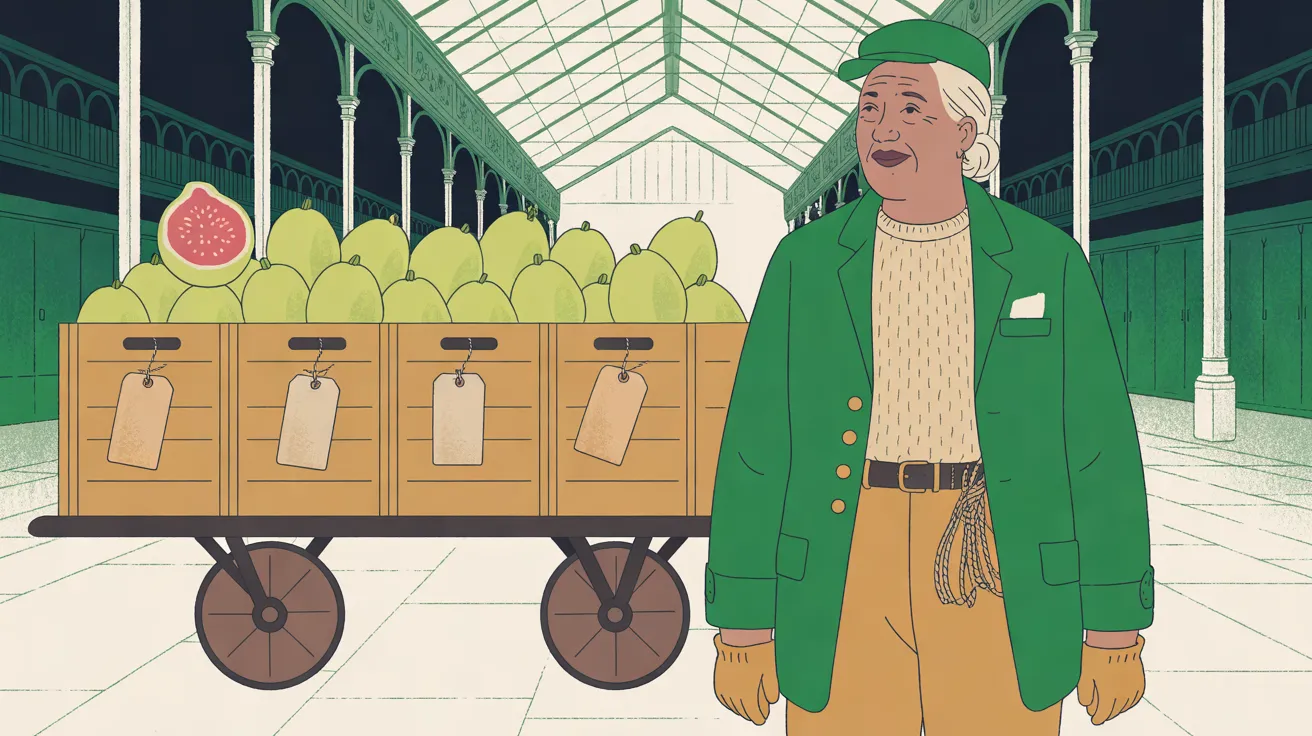
If Guava is your strain, this is your sign: the Dawn Porter. The fruit hall at ten to five, first light pale on the glass roof, the lamps still humming, and you beside a long barrow of guavas with a tag on every crate.

The Dawn Porter, an older woman with light, weathered skin and white hair pinned up under a flat forest-green cap, stands at the right, seen from the thighs up and looking off to the left with a slight smile, in a forest-green jacket with brass buttons over a cream knit sweater, tan trousers with a coil of string at her belt, and tan work gloves. To her left a long flat wooden barrow on two large spoked wheels carries a row of wooden crates heaped with pale-green guavas, one split open to show its pink centre, with a blank tan paper tag on string hanging from each crate. Behind them a market hall with white iron columns, green arcades and a pale glass roof stretches back over flagstones.
The barrow is loaded, the glass is going pale, and every crate has its tag.

If Guava is your strain

You are up before the market, and by the time anyone else arrives you have already decided where everything goes. You like the hour when the doors roll up and the cold comes in off the dock, when the hall is still blue and nobody needs anything from you yet except the right crate at the right stall. You like work you can finish.

You move fast and you never run. You know the hall the way other people know a song, every column and every corner, and you call out at the corners so nobody has to look up. You read a crate three ways before you trust it: the tag, the skin, your nose. People say you can tell where a fruit was grown with your eyes shut. You let them say it.

At your best you are the reason the morning works and nobody notices. Every stall opens to the right fruit, every tag says what is in the crate, and the lamps go off over a hall where everything is where it should be. You are generous with the new drivers, and patient with them, the first time.

Your flaw is that you cannot walk past a wrong tag. Not on someone else’s crate, not at a stall you do not serve, not on your break. You will stop the whole aisle to re-chalk one box, and you will be right, and the people waiting behind you will have to admit it. You know everyone’s business by their fruit, and sometimes you say so.

What you need is a clear aisle, a barrow that runs true, the loading doors open on a gold sky, and somebody to hand you something hot at six when the lamps go off. Give you that, and every crate finds its stall.

Your sign at a glance

Your hour
Ten to five
Your place
The aisle between the loading doors and the stalls
Your object
A long wooden barrow
Your tempo
Fast, never running
Your weather
Cold air off the dock, gold light through the glass
Your flaw
You can’t walk past a wrong tag

Your people

  • The Night Courier (Sour Diesel)The Night Courier signs off as you sign on. Some mornings you pass at the loading doors, his last envelope and your first crate, and you nod like two people who got the city through another night.
  • The Funky Gourmet (Blue Cheese)The Funky Gourmet is in your aisle by five, wanting the ripest crate for tonight. You always have one set aside, and you never tell him which stall it came from.
  • The Sprinter (Green Crack)The Sprinter’s mangoes come through your hall still wet from the grove. You have never seen a race, but you can tell from the crates what kind of morning it was.

Things you say

  • Same name, different orchard.
  • Tag, skin, nose. In that order.
  • Backs!
  • Nothing leaves my barrow without a tag.
  • If the lamps are still on, there’s still time.

A scene from your world

Every crate to its stall

The Dawn Porter is in the hall before the lamps are warm. At ten to five the loading doors roll up one after another, and the cold comes in off the dock smelling of rain and wet cardboard and, underneath, of fruit. She takes the barrow from its place against the third column, knocks each iron-rimmed wheel with the toe of her boot, and pulls her cap down. Overhead the glass roof is still night blue.

The first truck backs in with guavas. So does the second, and the third. Everyone in the hall calls them guava and means three different fruits: the pink ones from the hill farms, small and fierce; the pale coast ones that go to the juice stall; the old green river ones that nobody can grow on purpose. The drivers chalk a G on every crate and leave it at that. The porter does not leave it at that. She reads the paper tag on its string, then the skin, then, if she has to, she lifts a fruit and smells it, and only then does the crate go on the barrow.

She works the aisle the way the hall likes it, fast and never running, calling “Backs!” at the corners so the early stallholders step aside without looking up. Hill guavas to the stall with the green boards. Coast guavas to the juice stall by the doors. River guavas all the way down to the jam-maker at the end, who boils at ten past six and not a minute later. A tag for every crate, a crate for every stall, and the iron wheels saying the same thing on every flagstone.

The last truck is late. Its crates are tagged and chalked and stacked in the right order, and the porter almost lets the jam-maker’s crate go by. Almost. It smells wrong: sweet where it should be sharp, and when she turns a fruit over in her glove it is pink inside. Hill fruit, tagged for the river stall. Somewhere in the hall the jam-maker’s real river guavas are sitting under somebody else’s order.

She finds them under the juice stall’s coast load, three crates down, tagged for the wrong stall in a hand she recognizes. She does not say whose. She takes the chalk from her breast pocket, writes two new tags, ties them with the knot she has tied ten thousand times, and swaps the crates on the barrow while the first lamps above the doors click off.

She gets the river guavas to the end of the aisle as the gold light reaches the floor. The jam-maker lifts the lid, smells, nods, and reaches for the big pan, and never knows. The porter is already back at the dock with the empty barrow. “Same name, different orchard,” she says to nobody, and pulls her cap down for the morning.
The hall

The hall
Iron columns, a glass roof and a floor of worn flagstones, built for fruit and nothing else. Before six it belongs to the porters; after six, to everybody.
The loading doors
They roll up at ten to five, one after another, and let in the cold, the trucks and, on clear mornings, the first gold of the day.
The barrow
Long, flat and wooden, with two iron-rimmed wheels and handles worn pale where the hands go. It runs true if you treat it right.
The tags
Paper, on string, one to a crate: the farm, the fruit, a chalk letter. The porter reads them first and trusts them last.
The three guavas
Pink ones from the hill farms, pale ones from the coast, small green ones from the old river trees. Everyone calls them guava. Only some people know which is which.
The lamps
They hang from the girders on long chains and hum all night. When the sun reaches the glass they go off one by one, and the market is open.

The Dawn Porter, from every side

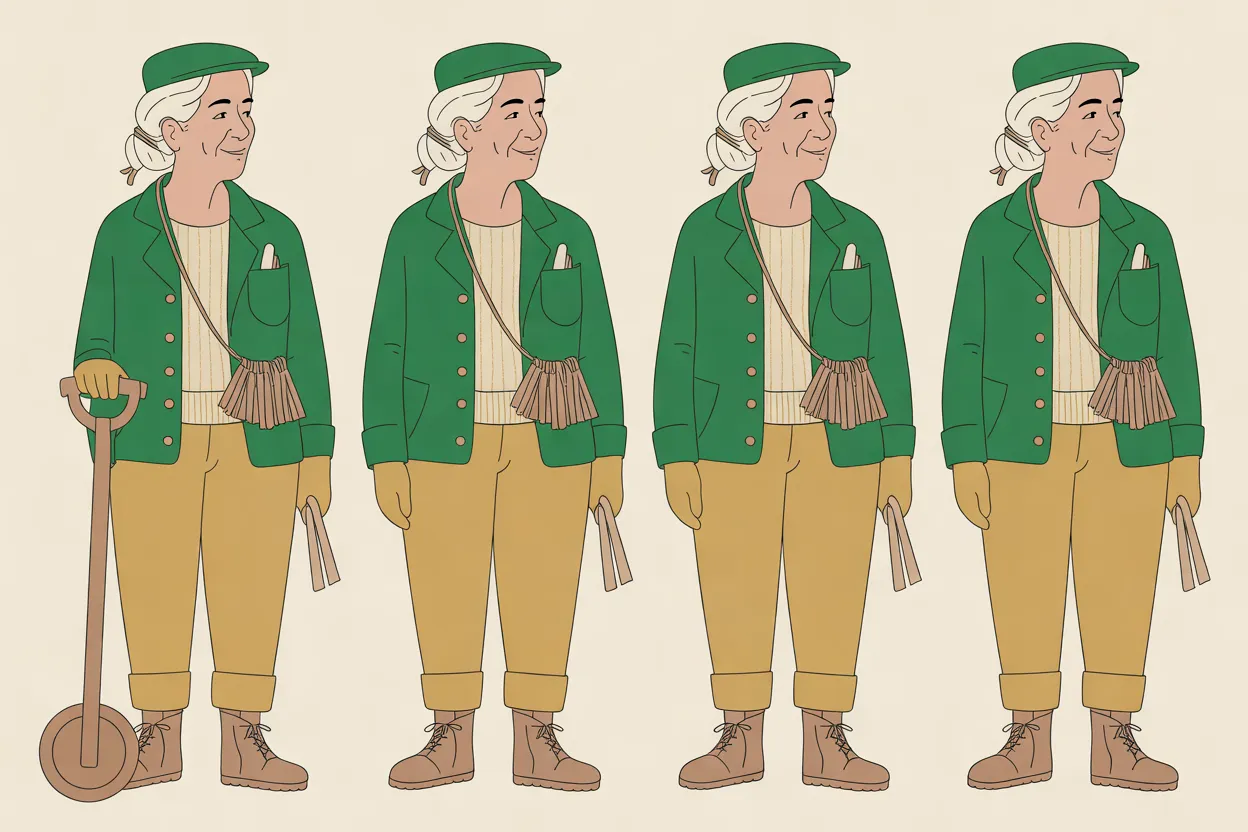
The Dawn Porter character sheet on a warm cream background: four full-length views of her turned three-quarters to the right, all with the same closed-mouth smile. In every view she has light skin and white hair tied in a low knot under a flat forest-green cap, and wears a forest-green jacket with brass buttons over a cream knit sweater, rolled tan trousers, tan gloves and brown lace-up boots, with a white stick in her breast pocket, a fringed tan bundle on a cord across her body and two tan strips in one hand; in the first view her other hand rests on a long wooden handle with a small wheel at its foot.
The Porter four times over: cap, jacket, chalk in the pocket and a bundle of tags, and one face for the whole dawn shift: the small smile when the last crate lands where it should.

An original character, created for Guava by Official Cannabis. Art direction by Official Cannabis.

Wear the tag

Pieces from this world come on a tee, a hoodie, stickers, a mug and a print.